
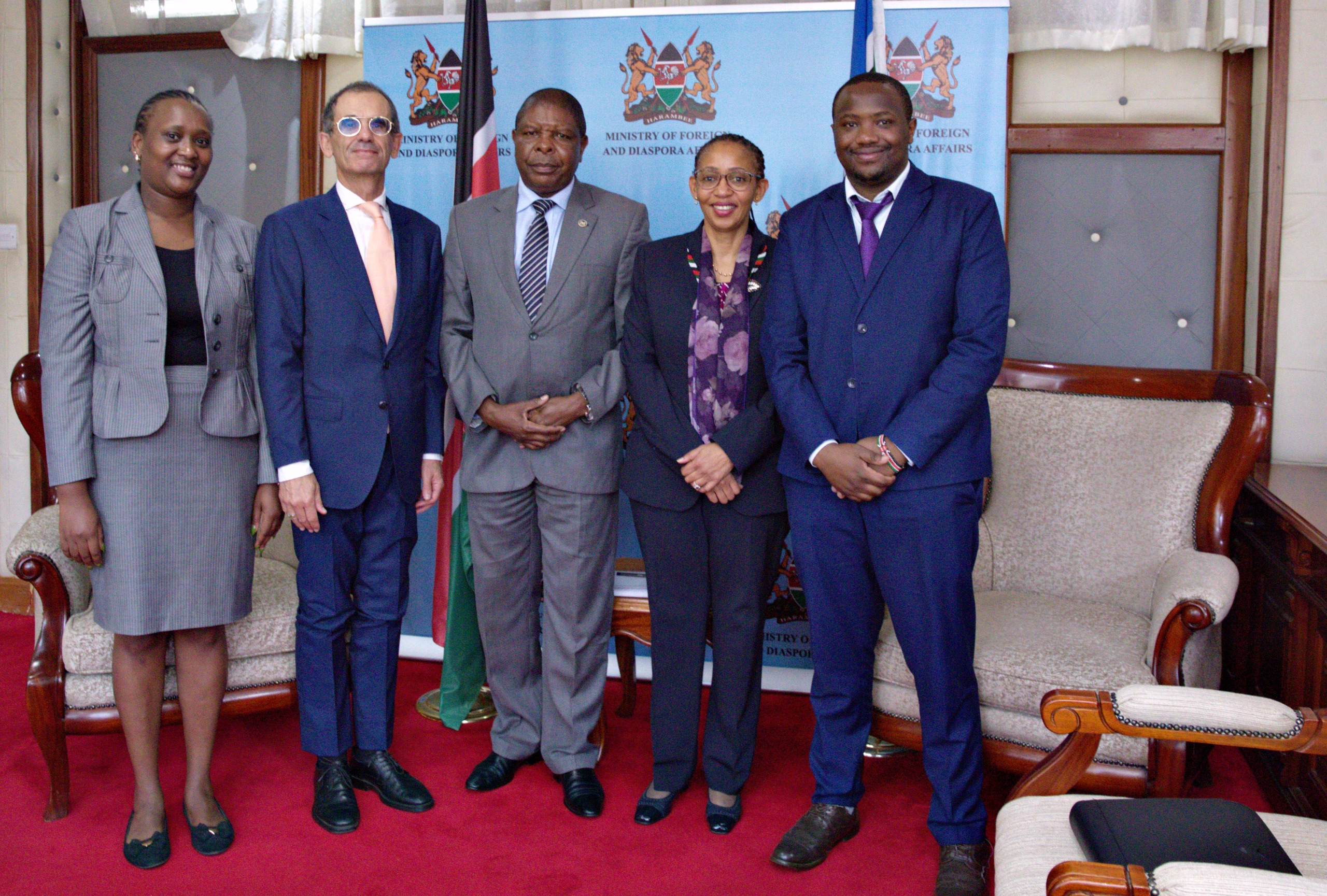
Kenya and Portugal Reaffirm Commitment to Deepening Bilateral Partnership
Kenya and Portugal have reaffirmed their commitment to strengthening their longstanding bilateral partnership, with a focus on translating strong political goodwill into tangible economic, strategic and development outcomes.
During a meeting held today at the Ministry Headquarters in Nairobi, the Director General, Political and Diplomatic Affairs, Amb. Josphat Maikara, met with the Ambassador of Portugal to Kenya, H.E. Mr. Paulo Neves Pocinho. The meeting was also attended by the Deputy Director General, Europe and Commonwealth Directorate, Amb. Tabu Irina.
Discussions focused on expanding trade and investment, enhancing air connectivity, advancing cooperation in the Blue Economy and maritime affairs, promoting Portuguese language training, and strengthening coordination on peace, security and multilateral issues. The two sides also underscored the importance of closer private-sector engagement and identifying new opportunities for mutually beneficial cooperation, while advancing shared priorities within the broader Africa–Europe partnership.
Ambassador Paulo Neves Pocinho succeeded H.E. Ana Filomena da Costa Rocha, who completed her tour of duty in Kenya in February 2026, and presented his Letters of Credence to H.E. President William Ruto on 6 May 2026.
Kenya and Portugal established diplomatic relations on 10 January 1977, and over the years, the relationship has evolved to encompass political, economic, educational, cultural and maritime cooperation. Key milestones include Portugal’s reopening of its resident Embassy in Nairobi in 2019 and the inaugural Kenya–Portugal Political Consultations, held in Nairobi on 15 April 2026 during the visit of Portugal’s Foreign Minister, Paulo Rangel.
The consultations provided an important platform for addressing bilateral, regional and international issues and reaffirmed the shared commitment to taking the relationship towards a more strategic, dynamic and sector-focused partnership.
Portugal is an important partner for Kenya, given its membership of the European Union, longstanding engagement with Africa, maritime expertise and capabilities in sectors that align closely with Kenya’s development priorities. Kenya sees considerable scope for expanding cooperation in trade and investment, agriculture and irrigation, the Blue Economy, renewable energy, climate action, tourism, infrastructure, ICT, education, research and health.
Portugal can also serve as an important bridge for Kenya’s engagement with the wider European Union, while Kenya offers Portuguese businesses a strategic gateway to the East African Community and the wider African Continental Free Trade Area market.
Bilateral trade, however, remains modest relative to the potential of the two economies. In 2024, Portugal’s exports to Kenya were valued at approximately US$8.6 million (about €7.9 million), while Portuguese imports from Kenya amounted to approximately US$13.9 million (about €12.8 million). The EU–Kenya Economic Partnership Agreement, signed in 2023, provides an additional framework for expanding trade, including duty-free, quota-free access for Kenyan exports to the EU market.
Kenya’s principal exports to Portugal include animal and vegetable fats and oils, processed fruits and vegetables, fish and other agricultural products, while Portugal’s exports to Kenya include pharmaceuticals, plastics, paper products, medical and technical equipment, machinery and other manufactured goods.
The two sides reaffirmed the importance of strengthening private-sector linkages, promoting trade and investment opportunities and identifying practical areas of cooperation capable of delivering tangible benefits to both countries. The discussions further underscored the potential for Kenya and Portugal to deepen their partnership in strategic sectors, while contributing to stronger Africa–Europe relations and advancing shared regional and global priorities.