
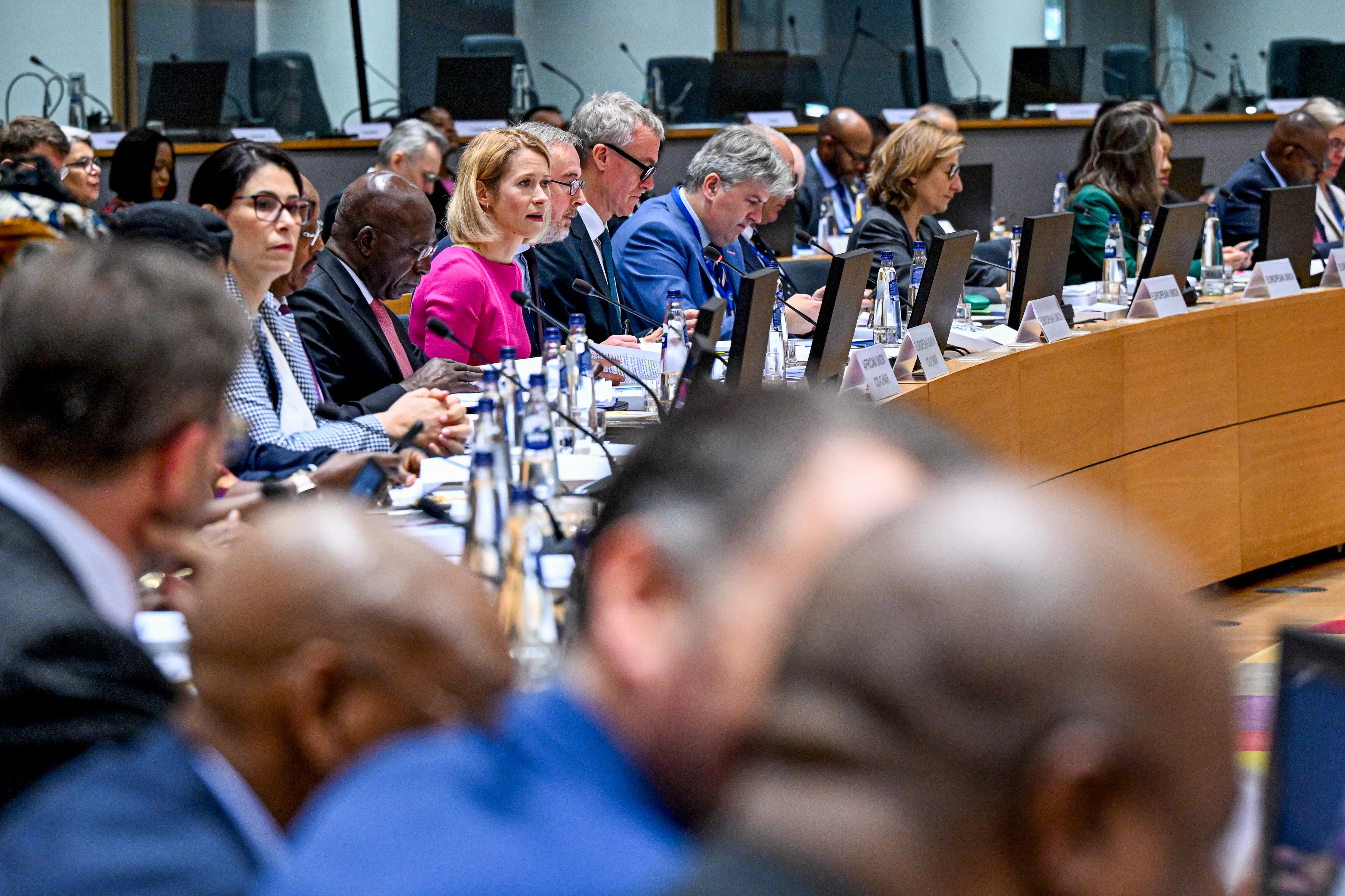
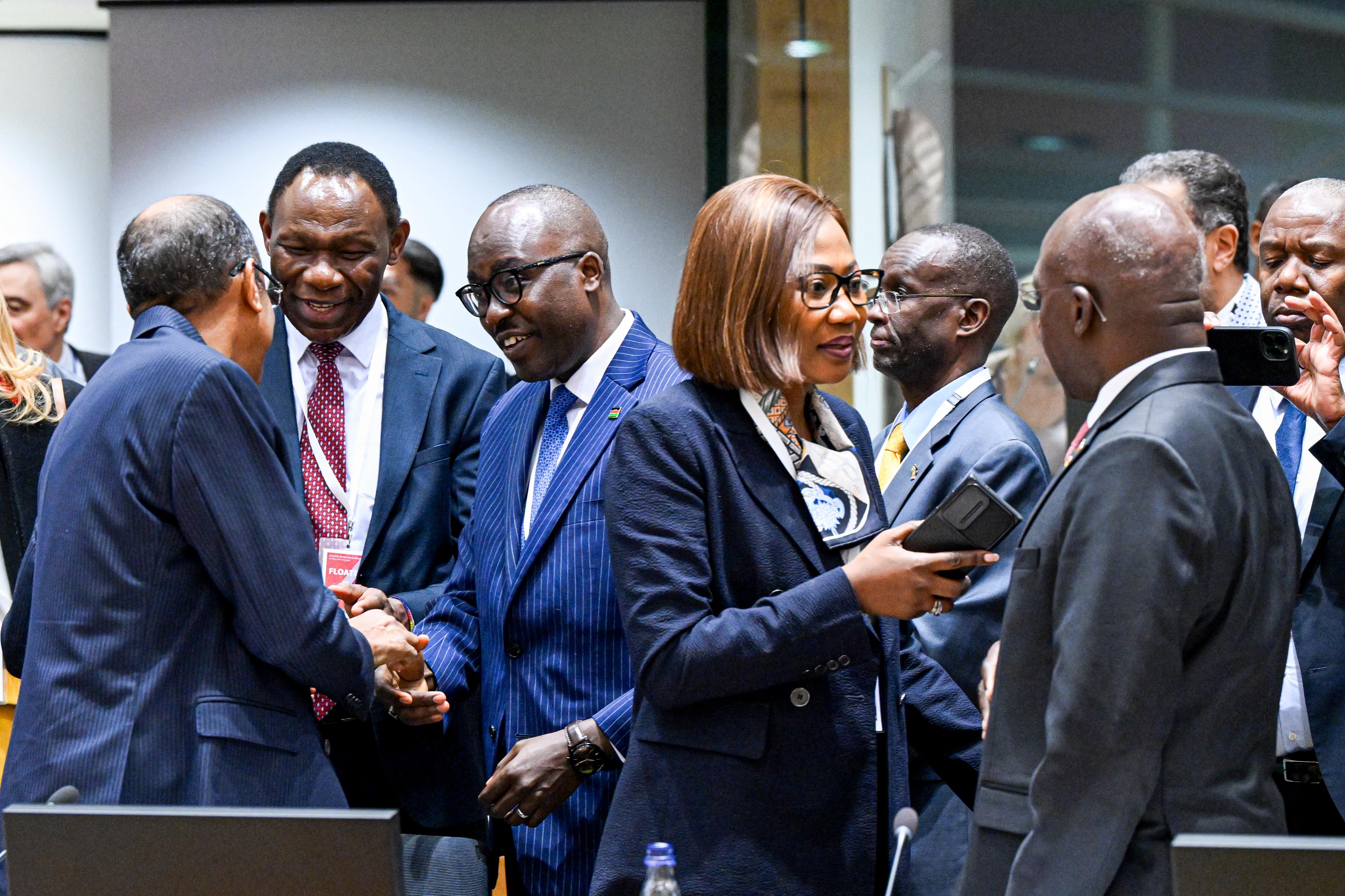
Kenya attends 3rd EU-AU Ministerial Meeting in Brussels
Ministers of Foreign Affairs of Member States of the European Union (EU) and the African Union (AU) recently concluded their 3rd Ministerial Meeting paving way for the 7th AU-EU Heads of State and Government Summit scheduled to take place in Africa later in the year. The planned summit will bring together 55 African Union members states and 27 European Union heads of state and their delegations to discuss a renewed and deepened AU-EU partnership for the future.
The AU-EU partnership while grounded in Africa’s Agenda 2063 sought to among others review a sustainable agenda for Africa and Europe; renew and enhance cooperation on peace, security and governance; enhance reciprocal partnership for Migration and mobility and commit to stronger Multilateralism. Kenya was represented at the Ministerial meeting by Foreign Affairs Principal Secretary Dr. Korir SingOei who on the sidelines, met counterparts from various countries in efforts to strengthen bilateral relations.
The EU- AU 3rd Ministerial meeting was co-chaired by Ms Kaja Kallas, High Representative of the European Union for Foreign Affairs and Security Policy and Vice-President of the European Commission, and Mr Téte António, Minister of External Relations of the Republic of Angola and Chairperson of the African Union Executive Council. The European Union and the African Union represent and carry the voices, hopes and dreams of more than 1.9 billion people.
The Ministers affirmed that the EU-AU Partnership continued to overcome past and current geopolitical challenges through shared commitment towards 2030 Agenda for Sustainable Development and the Paris Agreement, demonstrating the need for close cooperation for the mutual benefit of the people of Africa and Europe. The Ministers reaffirmed their commitment to the EU-AU Partnership, based on shared values, mutual respect and interests, and its continued relevance and reliability, against the backdrop of shifting global dynamics, rising geopolitical tensions and geo-economic competition, instability and fragmentation, heightened conflict, deepening inequality, as well as the impact of demography and migration and the triple planetary crisis of climate change, biodiversity loss and pollution on the continents.
The Ministers underscored their strong belief in effective multilateral cooperation and in the need to reform international institutions to collectively address shared global challenges. While reaffirming their collective commitment to address the root causes of conflict, they called for lasting peace in Ukraine, the occupied Palestinian Territories, Sudan, South Sudan, the Democratic Republic of the Congo (DRC), the Sahel and Syria. They also pledged to address cases of human rights violations, climate change and environmental degradation, combat terrorism and reject foreign interference.
On a prosperous and sustainable agenda for Africa and Europe, the Ministers welcomed the progress achieved in the implementation of the Global Gateway Africa-Europe Investment Package in 11 areas of mutual interest that closely aligns with priorities of the 2030 Agenda and AU Agenda 2063. These include investment in infrastructure in climate and energy; economic integration, private sector investment, sustainable agriculture, transport and corridors, critical raw materials, secure connectivity and digital transformation, health security and universal health coverage, value addition, job creation and skills development, education, sustainable financing, innovation and youth empowerment. The Ministers reaffirmed their commitment to ensuring the transformative impact of these investments through mobilising public finance and private capital and expertise. They also pledged to scale up cooperation on the blue economy for food security and the sustainable development of both continents.
Several of the Global Gateway Africa-Europe Investment Packages for Kenya and the Horn of Africa Region include but are not limited to: Construction of digital infrastructure for last mile connectivity of underserved areas, with a particular emphasis on sustainable, resilient and affordable school connectivity and on-site connectivity of TVET centres; EU-Africa-India Digital Corridor linking Djibouti; Ethiopia; Somalia; Tanzania; Kenya; and India; Mwache Water Project for Climate and Energy projects; Uganda - South Sudan Power Interconnection Project; Tanzanian sustainable urban food investment project (TASUFIP); Sustainable Coffee: Strengthening Value Chain and Climate Resilience in Africa covering Ethiopia; Uganda; Kenya; Tanzania; Malawi; and Côte d'Ivoire; Private Mobilisation Fund for Climate Resilience Investments in Land-Use and Water for developing countries; Infrastructure project in the Port of Pointe-Noire, DR Congo; amongst others.
The Ministers welcomed progress in the implementation of the African Continental Free Trade Area (AfCFTA) underscoring the establishment of a continental free trade area, for strengthening of economic integration and sustainable development of regional value chains and fostering trade in higher value-added goods and services, are key for the prosperity of both continents. The AfCTA when fully operational, will support job creation, particularly for women and young people, improve the business environment and investment climate and strengthen inclusive growth and sustainable development to ensure long-term stability and shared benefits. The AfCFTA represents an important opportunity to increase and diversify trade and investment across the African continent, particularly in strategic sectors.
On renewed and enhanced cooperation on peace, security and governance, the Ministers expressed their concern about the current threats to peace, security and governance. They expressed deep concerns over the growing humanitarian challenges, especially for the most vulnerable groups, including children, elderly people, people with disabilities and displaced people. They pledged support to strengthening the African Humanitarian Agency (AfHA), to effectively address the complex and multi-dimensional drivers of crises including climate change impact, environmental degradation, and water related conflicts, while promoting International Humanitarian Law and Human Rights Law, ensuring Humanitarian access, coordinating humanitarian assistance to reach people in need and fostering long-term resilience strategies through enhancing the Humanitarian-Development Nexus.
Cognisant of the various Common Security and Defence Policy (CSDP) engagements in place, the ministers called for closer peace and security cooperation that would address challenges such as political instability and armed conflicts, terrorism and violent extremism conducive to terrorism, transnational organised crime, including drug trafficking, trafficking in human beings, irregular migration, disinformation, piracy, maritime insecurity, cybersecurity and hybrid threats, and climate change and its security implications. The Ministers observed that cooperation in peacebuilding efforts and in peace operations at the level of the United Nations, the African Union, the Regional Economic Communities was critical in strengthening African peace and security architecture.
Ministers welcomed ongoing cooperation between the two continents on enhancing maritime security in the Ocean and sea bordering Africa and Europe. Ministers renewed their commitment to maintaining a rules-based maritime order in accordance with the principles of international law as reflected in the United Nations Convention on the Law of the Sea (UNCLOS) and called for greater exchange of information, improvement of operational coordination and provision of enforcement capacity to protect sea lanes and combat transnational crimes including drug trafficking and piracy. Ministers committed to work together to end Illegal, Unreported and Unregulated (IUU) fishing, take action to conserve and sustainably use the Ocean and sea as well as promote science-based management of marine resources.
On peace building in Somalia, the Ministers have reaffirmed their commitment to peace building, acknowledging EU support for AU missions. They support the hybrid implementation of UN Security Council Resolution 2719, recognizing the need for sustainable international support for AUSSOM. Concerning Sudan, the Ministers underlined that there was no feasible and lasting military solution to the situation, and that only true, inclusive discussion could resolve the present problem. They demanded an immediate and unconditional ceasefire in order to resume negotiations, halt the Sudanese people's suffering, and provide unrestricted humanitarian access across Sudan. The Ministers also committed to respecting the sovereignty and territorial integrity of Sudan, and pledged to support an inclusive Sudanese-owned and led political process, to be held preferably, under the AU/IGAD framework.
On the Congo, the ministers expressed their grave concerns about the worsening conflict and insecurity in the Eastern DRC, exacerbated by the humanitarian situation resulting from violence and human rights violations. They reiterated their support for the AU led mediation by the President of the Council of the Republic of Togo, H.E. Faure Essozimna Gnassingbe, South African Development Community (SADC) and East African Community (EAC) initiatives as well as other complementary peace initiatives conducted under the auspices of Qatar and USA, respecting the sovereignty and territorial integrity of the DRC.
The ministers remain perturbed by increased foreign information manipulation and interference and called for the development of human-centric Artificial Intelligence (AI) that respected human rights. The Ministers agreed to work together to support a single market for data in Africa as part of the AfCFTA and underlined the importance of secure connectivity in and between Africa and the EU. They urged for the development of regional innovation ecosystems that were safe, secure and trustworthy.
On enhanced and reciprocal partnership for migration and mobility, it was observed that, if well managed and in line with national needs and competences, migration remained an untapped opportunity, and catalyst for economic, social and human development. The 3rd Ministerial Meeting resolved to uphold the dignity, safety, and human rights of all migrants in line with obligations under international law and human rights frameworks. The Ministers reiterated the importance of investing in the youth through capacity building, mentorship, education, vocational training, employment and socio-economic development initiatives to empower young people.
The Ministers further agreed to strengthen migration governance and management while committing to foster cooperation on effective, safe, timely, and dignified return, readmission, and sustainable reintegration including promoting voluntary return, in full respect of international obligations as well as bilateral agreements. The Ministers have also committed to combatting migrant smuggling and human trafficking, with a strong focus on prevention. They called for capacity building in border management, fight against traffickers and reception of migrants and refugees.
On the issue of brain-drain, it was agreed would be addressed through mutually beneficial solutions, notably circular migration. In this regard, the Ministers urged for further engagement on education and mobility programmes to promote inclusive talent partnerships and mutual recognition of qualifications, to further expand access to student and academic exchanges, mutual skills recognition and digital education platforms that support youth and early-career professionals in building competencies across Africa and Europe. Concerning refugees, the 3rd Ministerial meeting reaffirmed commitment to resettlement of refugees. The Ministers recognised the significant role of the diaspora, its positive contribution to the sustainable development of the two continents and undertook to work together to address effectively relevant legal obstacles that affect its role in Africa’s development. The Ministers commended and acknowledged the positive contribution of migration dialogues between the two continents and promoted their synergy, notably the Joint Valletta Action Plan, the Rabat Process, the Khartoum Process, the Continent-to-Continent Migration and Mobility Dialogue, as well as the Rome Process, the AU Horn of Africa Initiative, and the joint AU-EU-UN Tripartite Task Force.
On strengthening multilateralism, the Ministers reaffirmed their commitment to promoting inclusive and effective multilateralism and a rules-based international order emphasizing the importance of dialogue and cooperation in multilateral fora on mutual interest issues. The Pact for the Future was recognised as a crucial step towards revitalizing the UN and achieving the Sustainable Development Goals. The ministers underscored the need for reforming global governance mechanisms, including the UN Security Council, to make it more representative, inclusive, and accountable. The EU was apprised of the activities of the AU’s Committee of Ten (C-10) Heads of State and Government in pushing and mobilising support for the Common African Position on UN reform. The Ministers agreed to work together on the UN80 initiative towards UN reforms for improved efficiency, cost-effectiveness and financial sustainability. On the World Trade Organisation, the 3rd Ministerial meeting called for a rules-based multilateral trading system that was responsive to the structural challenges and development needs of developing and least-developed countries. It is anticipated that during the 14th Ministerial Conference in Cameroon in 2026 the EU and the AU will seek common ground in negotiations to encouraging sustainable investments in Africa.
Ministers reiterated their commitment to combat illicit financial flows in line with International Financial Action Task Force standards and committed to collaborate on Anti-Money Laundering and Countering the Financing of Terrorism (AML/CFT). They deliberated on the challenges of the credit rating faced by African countries in accessing low-cost capital where the ministers underlined the importance of the involvement of private business and finance. The ministers also called for increased domestic resource mobilisation to address the financing shortfalls and committed to contribute to reforms on the international tax architecture.
While reaffirming their strong commitment to the United Nations Framework Convention on Climate Change and the Paris Agreement, the ministers have called for scaling up climate finance flows to support adaptation, resilience, mitigation, and loss and damage, especially for vulnerable communities. They also acknowledged the importance of supporting mitigation, disaster risk management, and early warning in Africa. The ministers also pledged to work together to address the impact of climate change on countries, bridge their climate financing gap, and address water scarcity, desertification, deforestation, forest degradation, and support afforestation and agroforestry.
Ministers welcomed the convening of the 2nd Africa Climate Summit in September 2025 in Addis Ababa, to be hosted jointly by Ethiopia and the AU Commission as well as the convening of the 1st Africa Biodiversity Summit to be hosted by the Republic of Botswana in October 2025.
The 4th EU-AU Ministerial Meeting will be held in 2027 in Africa.