
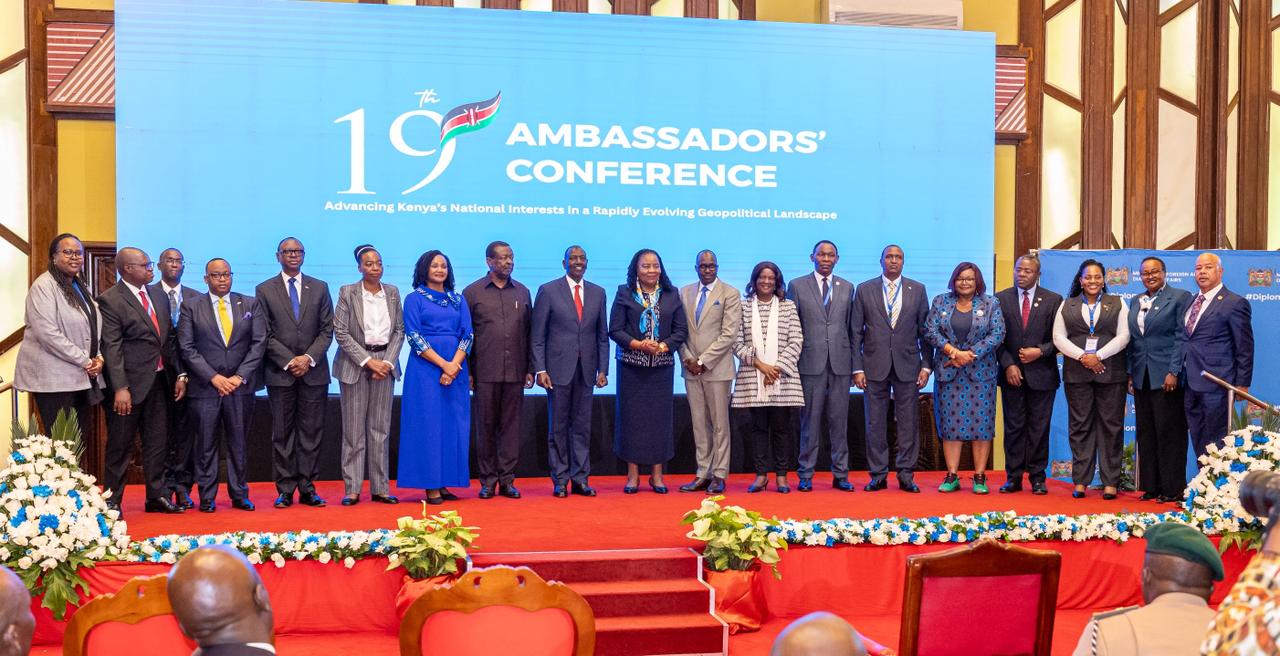
Kenya Positions itself for assertive diplomacy at the 19th Ambassadors' Conference
Kenya has signaled a more assertive and strategically aligned foreign policy posture, as President William Ruto used the opening session of the 19th Ambassadors’ Conference to outline an ambitious diplomatic agenda anchored in economic transformation, multilateral engagement, and geopolitical balance.
In a keynote address delivered in Nairobi, President William Ruto framed Kenya’s foreign policy as a critical instrument for advancing national development priorities, urging diplomats to recalibrate their missions toward tangible economic outcomes. He emphasized that diplomacy must increasingly serve as a “frontline engine” for trade expansion, investment attraction, and regional integration.
At the heart of Kenya’s diplomatic shift is a renewed focus on economic diplomacy. The President called on envoys to actively pursue market access for Kenyan goods, promote value-added exports, and position the country as a competitive investment destination.
“We encourage you focus on bilateral and multilateral relationships to reduce trade imbalances and enhance Kenya’s participation in global value chains. This aligns with our nationl broader strategy of reducing dependency on imports while scaling up manufacturing and agro-processing sectors.” He said
President Ruto further highlighted the importance of aligning diplomatic missions with flagship national programs, including industrialization, the digital economy, and climate resilience areas he described as “non-negotiable pillars” of Kenya’s long-term prosperity.
Reaffirming Kenya’s role within regional and global institutions, the President pointed to the country’s leadership in the African Union and its active engagement at the United Nations as key platforms for advancing African interests.
He stresses the need for coherent African positions on global challenges, including climate financing, debt sustainability, and security cooperation. Kenya’s diplomats were urged to champion reforms in global governance structures to ensure fair representation for developing economies.
Regionally, Kenya’s commitment to stability in the Horn of Africa and the Great Lakes region was reiterated, with diplomacy framed as essential to conflict prevention and peacebuilding.
In a notable shift toward results-driven diplomacy, the President introduced a stronger emphasis on accountability within Kenya’s foreign service. Missions abroad will increasingly be evaluated based on measurable outcomes, including trade volumes, investment inflows, and strategic partnerships secured.
On his part Prime Cabinet Secretary and Cabinet Secretary for Foreign and Diaspora Affairs Musalia Mudavadi highlighted the conference as a critical platform for reflection, coordination, and forward planning among Kenya’s diplomatic corps.
He underscored significant foreign policy achievements, including strengthened global engagement, expanded bilateral partnerships, and Kenya’s growing influence in peace, security, and climate diplomacy.
He underscored progress in institutional reforms, including the 2025 Foreign Policy framework and the adoption of open diplomacy to involve citizens and counter misinformation. Kenya’s diplomatic footprint has expanded to 72 missions globally, enhancing strategic presence despite resource constraints.
A key highlight is the establishment of the State Department for Diaspora Affairs, which has strengthened protection, engagement, and investment mobilization from Kenyans abroad. Diaspora remittances are increasingly being redirected toward development-oriented investments.
In his remarks, PS Foreign Affairs Dr Korir Sing’oei framed the current global environment as a “moment of reckoning,” urging ambassadors to act collectively in safeguarding Kenya’s national interests amid rising global uncertainties.
The 19th Ambassadors’ Conference reflects a broader recalibration of Kenya’s external engagement strategy one that seeks to balance traditional alliances with emerging partnerships while prioritizing national economic interests.
As global geopolitical dynamics continue to evolve, Kenya’s renewed diplomatic focus suggests a deliberate effort to enhance its influence on the international stage while delivering concrete benefits at home.
In redefining the role of diplomacy, Nairobi appears intent on transforming its foreign missions into active instruments of economic growth and strategic positioning marking a significant shift in how the country engages with the world.