
President Ruto Rallies Global Parliaments to Strengthen Action Against Hunger at Nairobi Summit
President Ruto Rallies Global Parliaments to Strengthen Action Against Hunger at Nairobi Summit
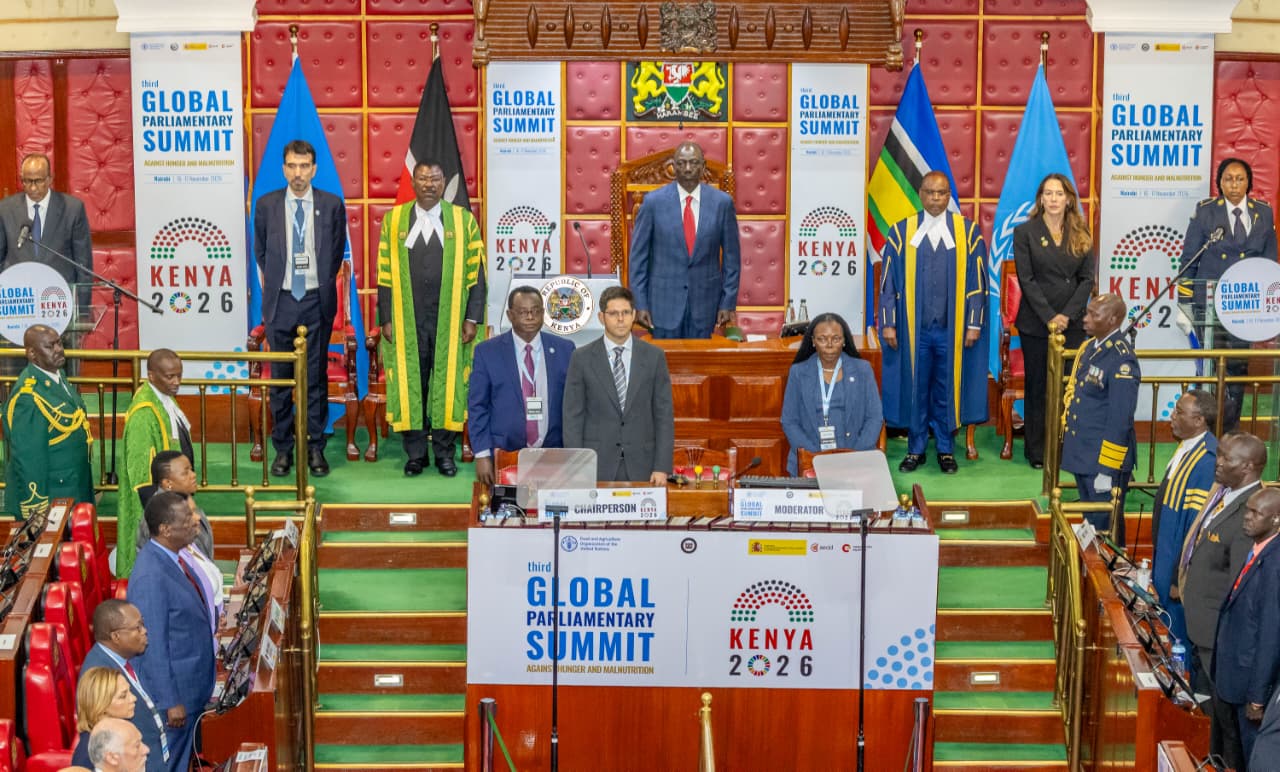
Nairobi, 16 November 2026 – H.E. Dr. William Samoei Ruto, President of the Republic of Kenya and Commander-in-Chief of the Defence Forces, has called on parliaments across the world to leverage their legislative authority, budgetary powers and parliamentary diplomacy to accelerate the fight against hunger and malnutrition, urging lawmakers to translate political commitments into tangible improvements in food security.
Speaking during the opening of the Third Global Parliamentary Summit Against Hunger and Malnutrition in Nairobi, President Ruto said ending hunger required sustained political commitment, effective legislation, targeted investment and stronger international cooperation.
The Summit, being held in Africa for the first time, has brought together 250 parliamentarians from 65 countries, alongside development partners and other stakeholders, to advance collective solutions to hunger through inclusive development, access to nutritious and affordable diets, and resilient agri-food systems.
President Ruto challenged legislators to move beyond declarations and ensure that commitments are supported by enforceable laws, adequate financing and effective oversight.
“If hunger is shaped by public decisions, then ending it requires legislation, budgets and oversight,” he said.
He emphasised that the right to adequate food must be backed by deliberate policy interventions and sustainable financing, warning that commitments without corresponding budgetary allocations would have limited impact.
“A right without a budget line is a slogan,” President Ruto said, urging parliamentarians to scrutinise public expenditure and ensure that investments in agriculture, irrigation, school feeding and social protection deliver measurable results.
The President reaffirmed Kenya's commitment to agricultural transformation as a foundation for economic growth, job creation and food security. He cited the distribution of more than 38 million bags of subsidised fertiliser to nearly two million farmers since 2022 and plans to bring an additional 2.5 million acres under irrigation within the next five to seven years.
He also outlined plans to expand the national school feeding programme across all 47 counties from 2027, targeting 10 million learners by 2030, while linking school meals to local agricultural production to create markets for smallholder farmers.
President Ruto further called on African legislators to leverage parliamentary diplomacy to advance regional agricultural trade, mobilise climate financing and strengthen Africa's participation in global economic decision-making.
He reaffirmed Kenya's commitment to the African Continental Free Trade Area (AfCFTA), describing it as a critical framework for expanding agricultural markets, strengthening regional food systems and accelerating economic growth.
He urged member states to address non-tariff barriers that continue to impede cross-border trade in agricultural products and harmonise standards to facilitate the movement of goods across the continent.
“For Africa to feed itself and the world, we must unlock the full potential of intra-African trade,” the President said.
H.E. Mr. Maurizio Martina, Deputy Director-General of the Food and Agriculture Organization of the United Nations (FAO), commended Kenya's leadership and the Government's prioritisation of agriculture through interventions aimed at reducing input costs, expanding irrigation, increasing production and strengthening value addition.
“Hunger is not inevitable. We cannot confuse progress with success,” Mr. Martina said, calling for food systems that guarantee not only increased production but also access to affordable and healthy diets.
He underscored the strategic role of parliaments in translating citizens' needs into national priorities through legislation, budgeting and accountability.
The Summit is taking place against a backdrop of persistent food insecurity, with an estimated 645 million people facing hunger globally in 2025, including approximately 309 million in Africa. In Kenya, an estimated 2.7 million people face crisis levels of food insecurity.
The Nairobi meeting builds on previous summits held in Madrid, Spain, in 2018, and Valparaíso, Chile, in 2023. Its deliberations focus on realising the right to food through inclusive development, improving access to nutritious diets and strengthening sustainable agri-food systems.
Through hosting the Summit, Kenya is reinforcing its position as a centre for multilateral dialogue while advancing parliamentary diplomacy as an instrument for collective action towards achieving Sustainable Development Goal 2: Zero Hunger.
ENDS